
Ever since Eve encountered Satan’s barrage of doubt and denial (Gen. 3:1–7), mankind has continued to question God’s word. The Scriptures certainly have more than enough content to be interrogated, considering that it’s comprised of 66 books, 1,189 chapters, 31,173 verses, and 757,444 words. When you open your English translation to read or study it, you might have asked in the past or are currently asking now, “how can I be sure this is the pure and true word of God?” A question of this kind is not altogether bad, especially when one seeks to learn with a teachable mind (Acts 17:11). Unlike other religions, Christianity welcomes thought-provoking questions, and it is not afraid to lay out its truths to be tested because those who have experienced a transformed life know that if you ask, seek and knock with a humble curiosity, you may just be changed by the Author of life itself. We must understand though that if the Bible is what it claims to be, God’s infaliable word, and it is true, then we are not simply questioning the validity of words written in a book, but the very words and character of God Himself.
This is where the book begins, in the garden, where God created everything in the universe in six days and turned it over to mankind to have dominion over all of creation but instead of trusting the Lord and Creator of the universe, we doubted Him and fell into great sin which carries its marks in us and throughout creation, even to today. So let us tread carefully, but let us look with a humble heart and an inquizative mind, prepared to follow where the evidence leads us. Let’s start by looking at some facts that makes this book credible and figure out how it came to be.
Take the Bible and let it speak for itself. This principle of Bible interpretation is both logical and God-honoring (Genesis 41:15-16). Does it claim to be God’s word? Yes! Over 2,000 times in the Old Testament alone, the Bible asserts that God spoke what is written within its pages. From the beginning (Gen. 1:3) to the end (Mal. 4:3) and continually throughout, this is what Scripture claims. Is this self proclamation on its own enough evidence? No, not necessarily, but it could be simply enough if we believed that the author is God Himself.
The Bible does not expect its reader to speculate on how these divine qualities were transferred from God to his word, but rather anticipates the questions with convincing answers. Every generation of skeptics has assailed the self-claims of the Bible, but its own explanations and answers have been more than equal to the challenge. The Bible has gone through God’s publishing process in being given to and distributed among the human race. Its several features are discussed below.
Revelation
God took the initiative to disclose or reveal himself to mankind (Heb. 1:1). The vehicles varied; sometimes it was through the created order, at other times through visions/dreams or speaking prophets. However, the most complete and understandable self-disclosures were through the propositions of Scripture (1 Cor. 2:6–16). The revealed and written word of God is unique in that it is the only revelation of God that is complete and that so clearly declares man’s sinfulness and God’s provision of the Savior.
Inspiration
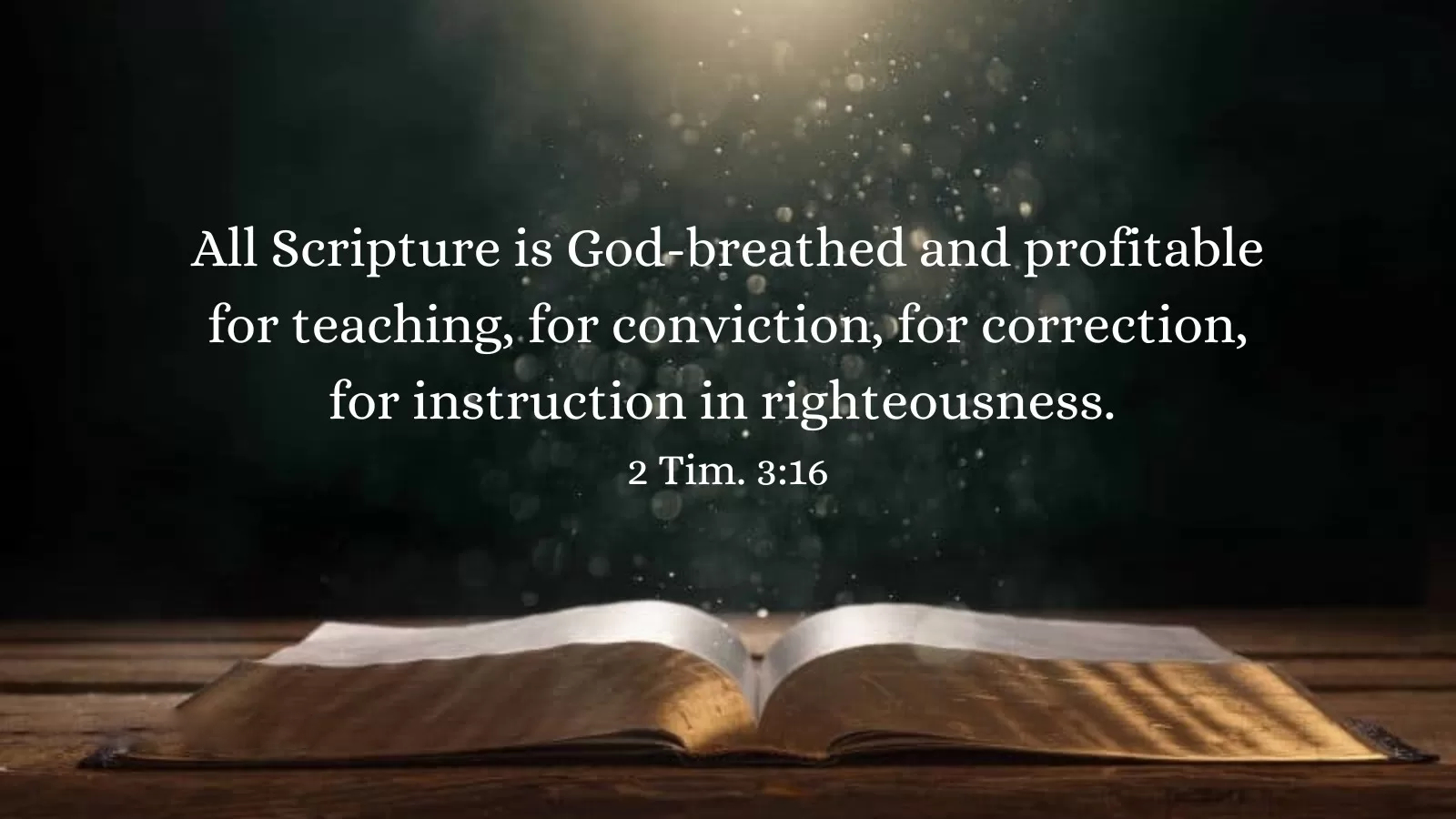
The revelation of God was captured in the writings of Scripture by means of “inspiration.” This has more to do with the process by which God revealed himself than the fact of his self-revelation. “All Scripture is breathed out by God . . .” (2 Tim. 3:16) makes the claim. Peter explains the process, “. . . knowing this first of all, that no prophecy of Scripture is comes from someone’s own interpretation. For no prophecy was ever produced by the will of man, but men spoke from God as they were carried along by the Holy Spirit” (2 Pet. 1:20–21). By this means, the word of God was protected from human error in its original record by the ministry of the Holy Spirit (cf. Deut. 18:18; Matt. 1:22). A section of Zech. 7:12 describes it most clearly, “. . . the law and the words that the Lord of hosts had sent by his Spirit through the former prophets.” This ministry of the Spirit extended to both the part (the words) and to the whole in the original writings.
Canonicity
We must understand that the Bible is actually one book with one Divine Author, though it was written over a period of 1,500 years through the pens of almost 40 human writers. The Bible began with the creation account of Gen. 1–2, as we discussed in the introduction, written by Moses about 1405 b.c., and extends to the eternity future account of Rev. 21–22, written by the apostle John about a.d. 95. During this time, God progressively revealed himself and his purposes in the inspired Scriptures. But this raises a significant question: “How do we know what supposed sacred writings were to be included in the canon of Scripture and which ones were to be excluded?”
Over the centuries, three widely recognized principles were used to validate those writings which came as a result of divine revelation and inspiration. First, the writing had to have a recognized prophet or apostle as its author (or one associated with them, as in the case of Mark, Luke, Hebrews, James, and Jude). Second, the writing could not disagree with or contradict previous Scripture. Third, the writing had to have general consensus by the church as an inspired book. Thus, when various councils met in church history to consider the canon, they did not vote for the canonicity of a book but rather recognized, after the fact, what God had already written.
With regard to the Old Testament, by the time of Christ all of the Old Testament had been written and accepted in the Jewish community. The last book, Malachi, had been completed about 430 b.c. Not only does the Old Testament canon of Christ’s day conform to the Old Testament which has since been used throughout the centuries, but it does not contain the uninspired and spurious Apocrypha, that group of 14 rogue writings which were written after Malachi and attached to the Old Testament about 200–150 b.c. in the Greek translation of the Hebrew Old Testament called the Septuagint (LXX), appearing to this very day in some versions of the Bible. However, not one passage from the Apocrypha is cited by any New Testament writer, nor did Jesus affirm any of it as he recognized the Old Testament canon of his era (cf. Luke 24:27, 44).
By Christ’s time (0-33 a.d.), the Old Testament canon had been divided up into two lists of 22 or 24 books respectively, each of which contained all the same material as the 39 books of our modern versions. In the 22 book canon, Jeremiah and Lamentations were considered as one, as were Judges and Ruth.
The same three key tests of canonicity that applied to the Old Testament also applied to the New Testament. In the case of Mark and Luke/Acts, the authors were considered to be, in effect, the penmen for Peter and Paul respectively. James and Jude were written by Christ’s half brothers. While Hebrews is the only New Testament book whose authorship is unknown for certain, its content is so in line with both the Old Testament and New Testament, that the early church concluded it must have been written by an apostolic associate. The 27 books of the New Testament have been universally accepted since c. a.d. 350–400 as inspired by God.
God did not leave His word up to chance. He guided it along through the ages and preserved it perfectly. The Bible we have today can be trusted as God’s infallible word and as it states in 2 Timothy 3:16, we have a divine book that is God-breathed. Many try to argue that it was merely written by men however God ensured this is not true for He lays out in 2 Peter 1:16-21, “know this first of all, that no prophecy of scripture is a matter of one’s own interpretation, for no prophecy was ever made by an act of human will, but men moved by the Holy Spirit spoke from God” and therefore, it became the Holy Scriptures we know today as God’s Word. There is none like it. It has been tried, tested and proven and if that is still not enough, know that it transforms lives and it can transform yours if you seek its pages with humility. God will meet you on it’s pages and reveal Himself to you there, He did it for me. If you still have questions or are still a skeptic, check out our web page titled, “How did we get the Bible?“. Now watch these episodes below for some amazing history and answers to the question, can I trust the Bible?
This 3-part series below titled, “Can I Trust the Bible”, from Bible scholar and apologist, Wes Huff, takes this question head on and helps us to understand why we can trust the Bible and how it came to be what it is today. Click the drop-down arrows to reveal the videos.
Can I Trust the Bible – Episode 1: The Right Books
Can I Trust the Bible – Episode 2: The Right Text
Can I Trust the Bible – Episode 3: The Council of Nicaea
“The underlying conviction is this: that God’s Spirit has been given to God’s people so that through God’s Word, God’s world might be brought to God’s Son. There is a sort of inherent logic in that progression. And we recognize that in the teaching of the Bible there is both the proclaiming of the truth, and then there is the receiving of the truth.”
Alistair Begg
We pray that through the proclaiming of this truth, the Lord would open your understanding and you would recieve the truth that is being proclaimed here.
Thank you for taking the time to read to the end of this article.
Remember, the Bible is the best selling book of all time. More copies have been sold than any other book in existence, so much so, they had to remove it off the best seller list because it would remain unmatched at #1 forever. With this in mind, if the Bible holds this level of status among all other books out there, fiction and non-fiction, then there must be validity in what it says.
The truth is, there is no other book in the world like it. There is no better way to understand our Creator—what He says about who He is and what He says about who we are—than by reading its pages. In this book, you will find the mysteries of life and true wisdom. You will learn how God defeated our greatest enemy, death, and how to find everlasting life, which scripture defines as a reconciled, intimate relationship with God through His Son, Jesus Christ (John 17:3).
In its pages, we meet God Himself. Through the faith He gives us as we read and hear the scriptures proclaimed, God can grant us this reconciliation from our fallen state. This state not only dates back to the beginning of creation (Genesis 3:1-24), but it also means that if we die in our sins, we will be eternally separated from the goodness of God, only to experience His wrath forever (2 Thessalonians 1:9-10).
There is salvation in no other name than the name of Jesus Christ (Acts 4:12, John 14:6, Isaiah 43:11). The Bible is that important
_______
Follow Herald the Truth Ministry and share this post to spread sound doctrine and gospel truth.
#heraldthetruth #truthmatters #gospeltruth #biblicalworldview #apologetics #solascriptura #solagratia #solafide #solusChristus #SoliDeoGloria
Visit our website at www.heraldthetruthministry.org
Leave a Reply